 CALL US! 904.406.7232 FREE CONSULTATION

St. Petersburg FL Public Adjuster | Gold Star Adjusters
Pinellas County Has No Inland Buffer. After Helene, Every St. Pete Property Owner Knows What That Means.
St. Petersburg sits on a peninsula within a peninsula — surrounded by Tampa Bay to the east, the Gulf of Mexico to the west, and Boca Ciega Bay threading through the barrier island communities to the southwest. There is no inland to retreat to in Pinellas County. When a major storm pushes water toward this coastline, it comes from multiple directions simultaneously, and it has nowhere to drain quickly once it arrives.
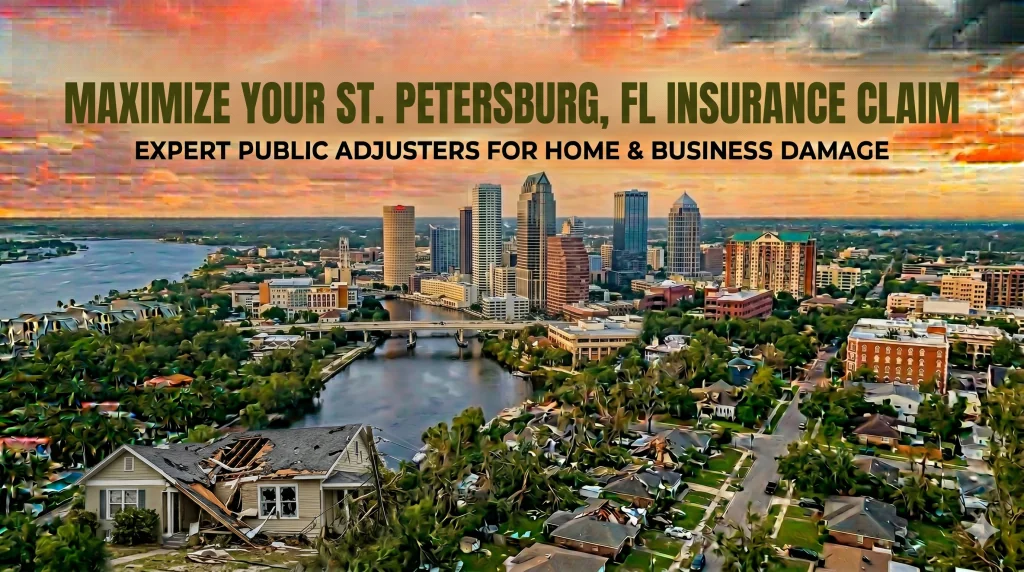
Hurricane Helene made that geography catastrophically clear in September 2024. The storm surge that devastated Treasure Island, St. Pete Beach, Pass-a-Grille, and communities throughout the barrier island chain was among the worst ever recorded on Florida’s Gulf Coast — and it reached inland Pinellas neighborhoods that had never flooded before, properties whose owners had no flood insurance because nothing in their history suggested they’d ever need it.
The claims cycle Helene set in motion is still very much in progress. If your St. Petersburg property was damaged and your claim hasn’t produced a settlement that reflects your actual loss, Gold Star Adjusters is here to help you see it through.
Pinellas County’s Flood Insurance Reality
Pinellas County carries one of the highest concentrations of National Flood Insurance Program policies in Florida — a reflection of how clearly residents here understand their water exposure. But Helene demonstrated that even that level of flood insurance penetration left significant gaps.
Properties in mandatory flood zones along the barrier islands and bay front carry both homeowners and flood policies, and the wind versus water causation dispute between those two carriers is the defining financial battle of most major Pinellas storm claims. Each carrier’s adjuster arrives with an incentive to attribute as much damage as possible to the other policy. Without independent documentation that establishes what the wind damaged and what the surge flooded — in what sequence, to which structural components — homeowners end up caught between two carriers and underpaid by both.
Properties outside designated flood zones that flooded anyway face a different and often more difficult situation. No flood policy means the entire loss falls on the homeowners policy — and homeowners carriers are aggressive about applying flood exclusions to damage they can characterize as rising water rather than wind-driven rain intrusion. The documentation battle over how water entered a structure, and under which policy provision it’s covered, is painstaking work that requires someone who has fought it before.
The Barrier Islands: Vacation Rental Claims Require a Different Approach
The barrier island communities — Treasure Island, St. Pete Beach, Pass-a-Grille, Madeira Beach, and Indian Shores — carry the highest concentration of vacation rental and seasonal residential property in Pinellas County. When Helene damaged or destroyed these properties, the financial loss extended well beyond structural repair costs.
Lost rental income during peak season, cancelled bookings, displacement of long-term tenants, and the carrying costs of properties that can’t generate revenue during an extended repair period — these are real financial losses that belong in insurance claims and that carrier adjusters focused on structural damage routinely miss entirely. Gold Star Adjusters documents rental income loss as a standard component of every barrier island claim we handle, using historical booking records, market rate data, and a complete picture of what the damage actually cost beyond the building itself.
Many barrier island properties also face the additional complexity of elevated construction requirements in coastal flood zones — when storm damage triggers repairs that must meet current FEMA and local building code elevation requirements, the cost increase can be substantial and belongs in the claim under ordinance and law coverage.
Historic St. Pete: Old Northeast, Kenwood, and Crescent Lake
Away from the waterfront drama, St. Petersburg’s historic residential neighborhoods carry the architectural character and restoration cost complexity familiar from other pages in our Florida portfolio — but with St. Pete’s own distinct flavor.
Old Northeast, Historic Kenwood, and the Crescent Lake neighborhood contain some of the finest examples of 1920s and 1930s bungalow, Mediterranean Revival, and Mission architecture in Florida. These homes — with their original hardwood floors, plaster walls, arched doorways, and period tile work — are precisely the properties that standard replacement cost estimating fails most dramatically. When storm or water damage affects a Historic Kenwood bungalow, restoring it properly means sourcing period-appropriate materials, engaging craftspeople who work with historic construction methods, and navigating St. Petersburg’s historic district permitting requirements — none of which shows up in a carrier’s generic damage estimate.
Downtown St. Pete’s Condo and Urban Residential Market
St. Petersburg’s downtown renaissance has produced one of Florida’s most vibrant urban residential markets — and one of its most complex insurance environments. High-rise and mid-rise condo owners throughout the downtown core, Edge District, and waterfront corridor carry HO-6 policies that interact with building master policies in ways that create real coverage gaps when damage occurs.
Water intrusion claims in multi-story buildings — whether from storm damage to the envelope, roof failures, or plumbing events in units above — involve questions about where the building’s responsibility ends and the unit owner’s begins that depend entirely on specific policy and condo declaration language. These are disputes that require someone who reads both documents carefully and knows how to make the case for the unit owner’s full entitlement.
Pinellas County’s Post-Helene Insurance Market
Helene’s impact on Pinellas County’s insurance market has been significant and is still unfolding. Several carriers have signaled intent to reduce their Pinellas exposure following the storm’s losses, and the claims environment for active Helene-related claims is increasingly adversarial as carriers look to contain their total loss exposure.
Homeowners who accepted early settlements — before the full scope of damage was understood or before mold had time to manifest in flood-saturated structures — may be sitting on losses that exceed what they were paid. Supplemental claims and reopened settlements are a significant part of what Gold Star Adjusters is working on throughout Pinellas County right now.
What We Handle in St. Petersburg
Gold Star Adjusters manages residential and commercial property claims throughout St. Petersburg and Pinellas County — hurricane and storm surge damage, flood and wind causation disputes, water damage and pipe leaks, fire and smoke, mold, roof damage, theft, vacation rental income loss, and high-rise condo coverage disputes. We conduct our own independent inspection, build thorough documentation, and negotiate directly with your carrier.
Our fee is a percentage of your final settlement. No upfront cost, no recovery means no fee.
Free Consultation for St. Petersburg Property Owners
Helene claims are active. Pinellas County’s insurance market is under pressure. The window for supplemental claims and settlement reviews is not unlimited.
Contact Gold Star Adjusters for a free consultation today.
Gold Star Adjusters serves St. Petersburg and all of Pinellas County — including Treasure Island, St. Pete Beach, Madeira Beach, Clearwater, Largo, Seminole, and the barrier island communities. Contact us for a free consultation.
Error: Contact form not found.